
(orig. published Mar. 3, 2024)
Sagas might be my favorite card type in all of Magic: the Gathering. They offer some of the most direct blends of narrative storytelling and gameplay mechanics, right down to their unique presentation.
While other card types can represent characters, places, and moments from a fantasy world, sagas depict stories told by people WITHIN that world, through a lens of in-world art (with an unusual vertical aspect ratio!). It’s a tricky extra design restriction, but extremely satisfying when pulled off correctly. And when the visual thirds of the art literally line up with the text effects? That’s the good stuff, right there.
This week’s earlier posts gave a glimpse into the lore on display in each of The Unwell Kingdom’s sagas, but now let’s take a closer look at the design work that went into each of them…
From the start, I decided to make a cycle of 2-color sagas so they could show up in a wide variety of decks, though I didn’t have a strong need for them to be any specific color pairs. You can see this choice in the banded ribbon of the custom saga frame I drew. Since the goal of these cards was to showcase cool stories from our campaign – specifically, the sorts of stories that characters themselves might tell – I knew it would be best in this case to let form follow function with top-down designs. Luckily for me, they slotted together quite nicely, with a bonus mono-white addition that popped up along the way!


 – The Fall of the Fell King
The most front-loaded of all the sagas, with its tale’s climax right at the start! We see the Fell King beheaded through the sanitized lens of a puppet show, perhaps the version of Crestfall history told to children by traveling bard caravans. I also wanted the art to emphasize stark light and shadows, to reinforce the color identity.
Mechanically, this is reflected by a spell with an immediate payoff in the form of targeted creature destruction. Compared to other sagas, this one almost feels like a removal spell with a fun bonus after the fact. That said, becoming the monarch provides some much-needed card draw in a limited format. The card positions you well to keep it, then rewards you by healing the kingdom (your life total) and forcing your new subjects to bow before you unless they can take the crown first!

 – Leviathan Tournament
The tale of the Leviathan Tournament felt like a natural mechanical fit for some good old Blue/White control. It’s a powerful mass bounce spell, especially for a common, so unlike the Fall of the Fell King, this one at least gives opponents a turn of warning! Narratively, this one feels extremely on the nose in the best way – First, the Leviathan searches far and wide for competitors (Scry), then the crowds are narrowed down to single champions (Bounce), and finally a king is crowned (You become the monarch)!
Eldoris itself proved to be a perfect visual fit here, as the glittering foil seaside kingdom to the sullen cliffs of Crestfall, and with its iconic colors of white, blue, and gold. I decided on a bright, tile mosaic to express this, though it could just as well be read as stained glass.

 – Birth of a Dragon
Black in this set is home to a Dragon sub-theme, including the Hoard mechanic. Each color has its own version of a dragon payoff card (more on those in a later Deep-Dive), and this is Red’s. While other hoard effects tend to steal cards from opponents and graveyards, Birth of a Dragon treats the mechanic more like Red impulse-draw, exiling cards from the top of your library but making you wait to play them. Once the final step creates a Dragon token, you can start playing those hoarded cards… including other cards that may have been hoarded prior! The Treasure tokens are equally flexible, letting you dip into an opponent’s colors to potentially cast their cards.
Visually, I decided to depict this myth through a woodcarving, as a nod to the Whittler being the only character in our campaign to know this secretive bit of lore.

 – Giants’ Day Festival
The art for the Giant’s Day Festival is essentially “Wizard Burning Man”, with huge figures and a trippy light show out in the desert. The color identity for this one was obvious. The story of two giants representing the land and the sea, down to visual motifs of a giant tree and falling water? Stop me if you’ve heard this one before…
It’s Blue/Green, so you already know it’s time to ramp some mana, but fortunately, there’s a bit more nuance here. Mill 5 is pretty significant, especially to do to yourself. On a surface level, that step is just making sure you have a land to bring back the next turn, but Blue in this set has a solid Mill package and can find ways to make use of cards in graveyard. Meanwhile, Green has a couple of rares that actually get stronger as your own deck thins out. And lastly, the saga’s final step, Lyros’s flood of tears, provides a powerful burst turn of mana reminiscent of High Tide. This gives the player a few turns to set up mana sinks and find X spells, while opponents also prep for the oncoming flood.
– The Ballad of Nasty Pete
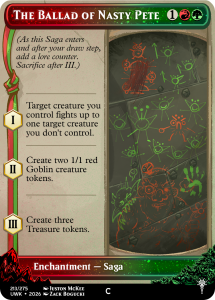
It takes efficient mechanical storytelling to sum up an adopted goblin’s life in three steps! Fight, family, prosperity. These are the three pillars at the core of Nasty Pete. This was the first saga I designed for the set, and its simplicity fits the ethos of the goblins of Contraption (and from a Magic standpoint, Red/Green in general). They know exactly what they want, and they’ll go get it.
This simplicity extends to the crude paintings scrawled onto Contraption’s metal walls, though there’s a distinct, almost childlike playfulness to them too. They land somewhere between ancient cave murals and a kindergartner playing with finger paints.

– The Queensguard Oath
This was a late addition to the sagas cycle, and sticks out like a sore thumb. Where the other sagas are all 3-4 mana value grinders, The Queensguard Oath is a speedy 2-mana tempo play that feels right at home in board-flooding aggro deck! Even from a narrative standpoint, it feels a bit flimsy, evoking a sort of illuminated manuscript recruitment poster.
While I wanted all colors to be represented in these sagas, I knew White would have a unique interest in running as many as possible, with its heavy “enchantments-matter” synergies… By giving white a higher density of playable sagas, this card manages to support both slower enchantment decks and quick aggro!